


Walk into a Roman market in late April and the calendar becomes irrelevant. The puntarelle have finished, the first fave are piled in shallow crates next to a block of pecorino, and someone is already arguing about whether the artichokes have another fortnight in them. Italian produce runs on its own clock, and the market is where that clock is displayed. Learn to read it and you stop guessing at the supermarket, stop paying for strawberries that taste of nothing in January, and start cooking the way the country actually eats.
Understand How the Market Works Before You Shop
Most Italian neighbourhoods still have a mercato rionale: a covered or open square of stalls that runs from early morning until roughly one in the afternoon, Monday to Saturday. Some are almost entirely fruit and vegetable vendors; others mix in a fishmonger, a butcher, a cheese stall and a bar where you take a coffee standing up. Alongside these are the smaller mercati contadini, where farmers sell what they grew, often twice a week in a piazza.
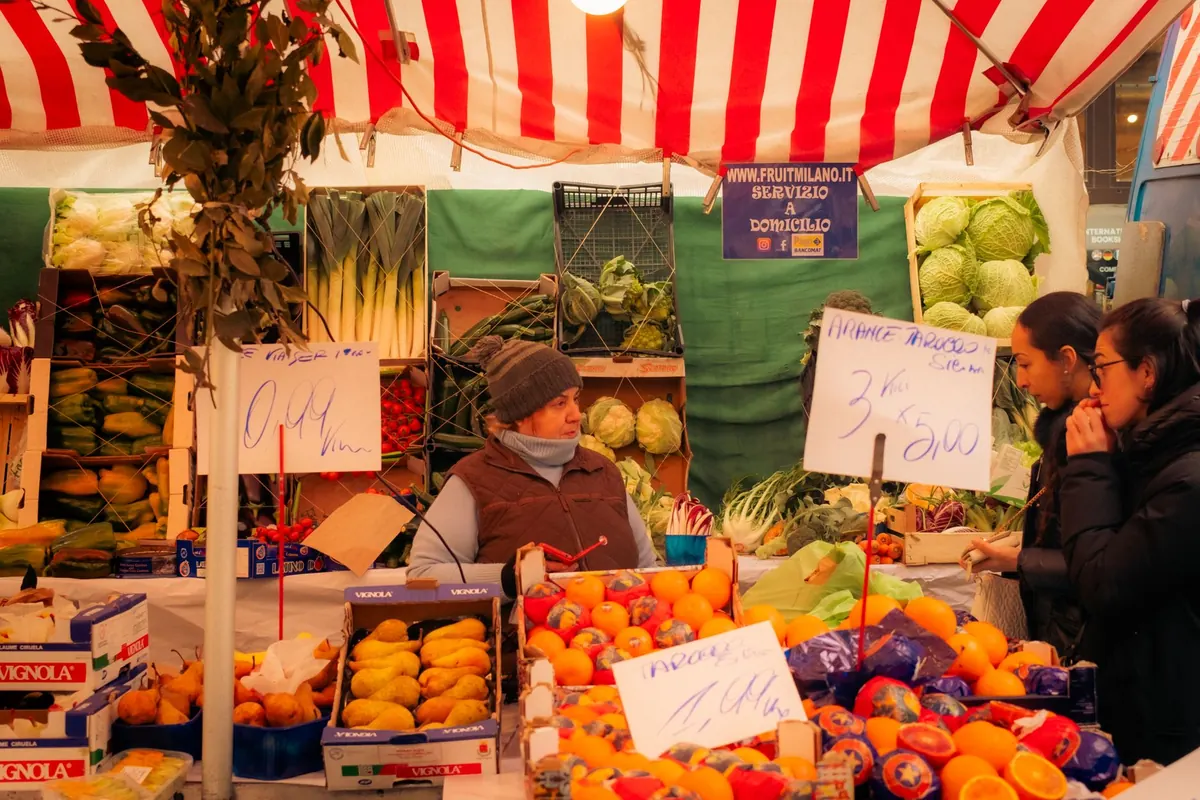
Two things are worth knowing. First, produce is usually priced by the kilo on a handwritten card, and asking "quanto costa?" is perfectly normal — vendors expect it. Second, the market empties fast. Arrive at half past twelve and you will meet the back of a van, not a selection. Sundays are largely dead, many stalls close on a Monday, and mid-August around Ferragosto the whole system thins out as vendors take their own holidays.
One more caveat: Italy is a long country. Apricots arrive in Sicily weeks before they appear in Trentino, and coastal Liguria runs a little later than the flatlands of Puglia. Treat any seasonal list as a shape rather than a rule, and let the stalls correct you.
March to May: Green Things and the Return of Colour
Spring begins with artichokes, and Italians treat them with a seriousness that outsiders find amusing until they taste one. Look for carciofo romanesco, round and purple-streaked, or the long, spiky violetto from Tuscany. A good one feels heavy for its size and squeaks when you squeeze it; the stem should still look alive rather than woody. In Rome, the same weeks bring puntarelle, a spiky green cataloga trimmed into curls and dressed with anchovy, lemon and oil — a dish worth planning a trip around.
Then come asparagus (the white version from Bassano, in Veneto, is a local obsession), spring onions, radishes, chard and spinach, and the first courgettes with their flowers still attached. Agretti, the salty-sour weed that looks like grass, appears briefly in Lazio and is best simply wilted in a pan with garlic.
May is the month to buy broad beans by the crate, shelling them at the kitchen table and eating them with pecorino and a little oil. Count on roughly half the weight being pod. Strawberries arrive properly in April and taste best from smaller stalls, where they were picked that morning. Loquats show up in May, and the first cherries usually land at the very end of the month.
June to August: Tomatoes, Stone Fruit, and Doing Less
Summer is when Italian cooking stops trying. Tomatoes dominate: cuore di bue for slicing, San Marzano for sauce, tiny datterini for pasta, Pachino from Sicily for anything at all. Smell the stem end and feel the weight — a tomato should be heavy in the hand and smell of the plant, not of the fridge. Never refrigerate them.
Aubergines come in two useful shapes: round and deep violet for Parmigiana, long and pale for grilling. Peppers, courgettes, cucumbers, green beans and bunches of basil with their roots still on fill the rest of the stall. Fruit is straightforwardly glorious: peaches, apricots, plums, melons sold by the slice to eat on the spot, and watermelons that vendors will thump and then cut for you to check.
By August the figs are in and the first grapes appear. This is also the month when the market is at its emptiest in terms of people and at its best in terms of produce. Go early, expect a shorter queue, and buy what is there rather than what you came for.
September to November: The Year's Richest Stretch
Autumn may be the best reason to live here. Mushrooms take over the stalls — porcini with pale, firm undersides, golden finferli, small chiodini for pasta. Wild mushrooms sold at Italian markets pass through a trained inspector, which is one good reason to buy them there rather than trusting your own eye in a wood.
Pumpkins arrive in serious varieties, from the dense, sweet delica to the knobbly marina di Chioggia. Chestnuts are heaped in sacks; choose glossy, heavy ones. Grapes, apples and pears come down from the north, and persimmons and pomegranates mark the turn of the season. Cabbages, broccoli, fennel and the great northern chicories — Treviso, Castelfranco, Chioggia — fill the crates that tomatoes occupied in July.
In late October and November, white truffles appear in Alba and the surrounding markets, priced by the gram and sniffed before buying. November also brings the year's first olive oil: cloudy, green, and peppery enough to make you cough. Buy a bottle from a stall that sells it in unlabelled litres and use it raw, on beans or bread, within a few months.
December to February: Citrus and Patience
Winter belongs to citrus. Blood oranges from Sicily — Tarocco, Moro, Sanguinello — arrive from December, along with mandarins, clementines, lemons from the Amalfi coast, and bergamot in Calabria. Pick fruit that feels heavy and has thin, tight skin; ask for a taste, which is rarely refused.
On the vegetable side, this is the season of cavolo nero, savoy cabbage, Romanesco broccoli, cauliflower, leeks, celery, spinach and fennel. Roman markets bring puntarelle back in January and February, and artichokes return in November and last through spring. Kiwi, apples and pears carry the fruit side, and stored pumpkins keep going well into the new year.
Winter shopping is slower, and that is the pleasure of it. There is less to choose from, so you choose better: a long-simmered cabbage with sausage, a fennel salad with orange and oil, a pot of beans with the last of the season's rosemary.
Habits That Make You a Better Market Shopper
- Bring cash in small notes. Many stalls now take cards, but not all, and never at the busiest moment.
- Learn three words of quantity. Un etto is 100 grams, mezzo chilo is half a kilo, un chilo is a kilo. That is most of what you need.
- Don't handle the produce. Point, ask, and let the vendor choose. They know which crate is better today, and they will pick well for you.
- Ask what's good. "Cosa c'è di buono oggi?" changes the transaction entirely. So does "di dove sono?" — the answer tells you the region and often the week.
- Say how you'll use it. "Per l'insalata" or "per il sugo domani" gets you different tomatoes, and better ones.
- Buy less, more often. Two smaller visits a week beat one heavy haul, especially in summer.
- Check the seconda scelta boxes. Slightly bruised peaches and misshapen peppers are cheap and perfectly good for jam, sauce or roasting.
Ask where the fruit is from, and a market stall stops being a shop and starts being a conversation.
A Simple Way to Start
Pick the month you are in, buy three things you already know how to cook, and ask one question per visit. Keep a note on your phone of what you bought and when it was at its best; within a year you will have your own calendar, more accurate than any chart because it is written for your market, your region and your kitchen. Then let the stalls do the rest. Eat what is in front of you, in the week it appears — that single habit will improve your cooking more than any technique, and cost you less than buying out of season ever did.
Photo: Apurva Chandwadkar / Pexels
Related posts
More stories you’ll love reading